
Accurate Temperature Measurement for Galvanizing Steel Strips
Precise temperature measurement of galvanizing steel strips is essential for ensuring high-quality coating and efficient production processes. Variations in temperature can directly affect the adhesion and durability of the zinc layer, making reliable monitoring critical throughout the galvanizing operation.
Watch This Video: How to Measure Temperature of Galvanizing Steel Strips Accurately
In-Depth Analysis: Detailed Breakdown of Galvanizing Steel Strip Temperature Measurement
How do we adapt a pyrometer to a specific application?
The engineer’s response to the customer’s request considers several key factors: the temperature range of the application, variations in emissivity, and the wavelength best suited for measuring the target material. The pyrometer we recommend meets all these requirements and offers additional slight advantages.
The customer requires a pyrometer equivalent to the competitor’s model. Our recommendation is based on analyzing the competitor’s specifications and providing the best matching alternative from our product range. If the customer seeks different performance criteria, they should supply us with a detailed specification of their requirements, enabling us to propose suitable replacement pyrometers accordingly.

We assume the customer's choice of this specification is due to the following reasons:
- Temperature range
- Emissivity changes
- wavelength suitable for measurement
The pyrometers A250 and A250C meets some of the requirements, but not all.
- Pyrometer A250, a single-wave pyrometer, cannot handle emissivity changes.
- Pyrometer A250C can handle emissivity changes, but measures in different wavelengths, and its minimum temperature is higher.

An error in the measurement of one wavelength pyrometer resulting from a change in emissivity of the measured target.
An illustration based on trials of galvanized or Zn-coated surfaces, which are not fully homogenized, and the emissivity changes from point to point.
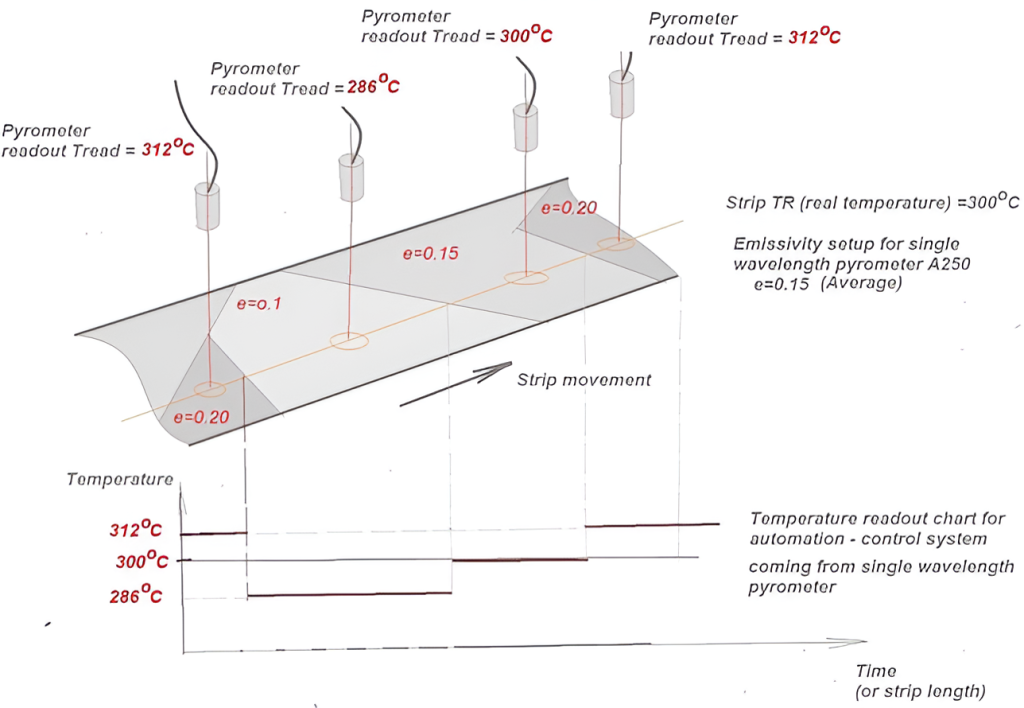
To demonstrate the measurement error, we used a simple sample with three different emissivity values: 0.1, 0.15, and 0.2. Since a single-wavelength pyrometer allows setting only one emissivity value, we chose an average emissivity of e = 0.15 for our calculations. We then evaluated the resulting measurement error caused by emissivity variations along the strip. The actual strip temperature was TR = 300°C, and the pyrometer wavelength used was λ = 1.6 µm. It is important to note that when using longer wavelengths (commonly employed for measuring lower temperatures), these emissivity variations lead to even greater measurement inaccuracies. These factors strongly support our recommendation of the A-2W pyrometer.

Several pictures from the
customer allow us to
accurately match the
pyrometer to the process.

